Press release —
Fred. Olsen 1848 completes pilot installation of Tension Buoy at EDP Floating PV Lab
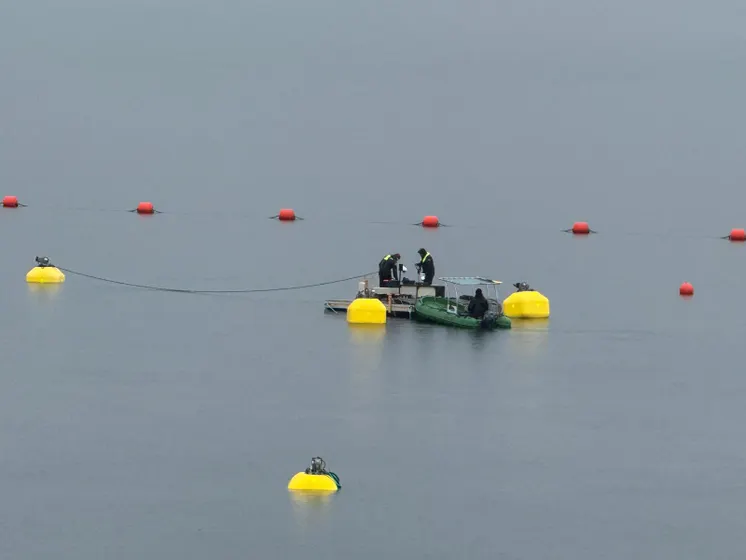
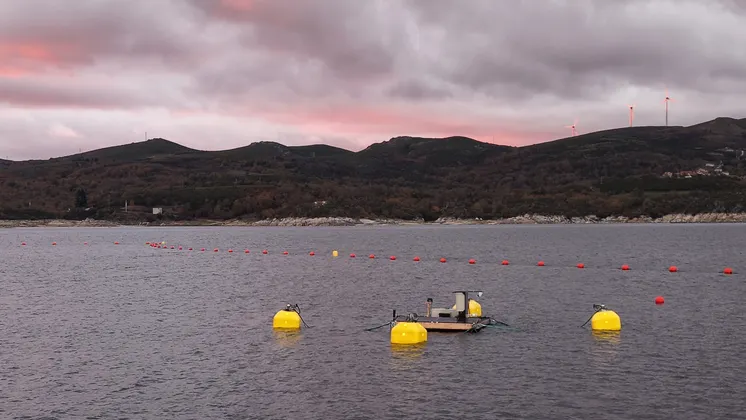
Fred. Olsen 1848 has successfully completed a pilot installation of four automatic Tension Buoy units at the EDP Floating PV Lab, Europe’s first open-access laboratory dedicated to testing technologies for floating and hydro solar power generation. With water levels that rise and fall by as much as 50 metres, this Portuguese dam lake is a great testing ground for the adaptive mooring system.
Unlocking New Potential for Floating Solar
Tension Buoy's adaptive mooring technology is designed to ensure stability and performance for FPV systems under large water level variations. Unlike conventional solutions, Tension Buoy’s self-adjusting tensioning system can be tailored to any site, enabling reliable operation in reservoirs and dams with virtually no limits on water-level range or bathymetry.
“By validating our technology in a dam lake with such large water level and bathymetry variations, we are uncovering the potential for floating solar and hydro power hybridisation. It’s a key step toward making hybrid renewable systems more adaptable and resilient,” said Even Hjetland, Principal Development Engineer at Fred. Olsen 1848 and a member of the installation team.

Fast, Efficient, and Collaborative Deployment
The installation was completed in just five days, underscoring the efficiency and simplicity of the Tension Buoy deployment process. The project was delivered in close collaboration with EDP, Sperra, and local partners, highlighting the importance of partnership in advancing next-generation renewable energy solutions. As part of this collaboration, Sperra’s innovative 3D-printed gravity anchor was deployed alongside the Tension Buoy system, providing an opportunity to validate novel anchoring technologies under the site’s extreme year-round conditions.
The pilot installation will continue to operate as a live demonstration for a year, providing valuable insights into system performance, reliability, and long-term maintenance. EDP’s Head of New Technologies and Special Projects, Pedro Miguel Oliveira, commented: “Through the Floating PV Lab, EDP strengthens its focus on innovation and positions this initiative as a strategic, collaborative platform. By closely monitoring technological evolution and performance, EDP secures a solid competitive edge in the development of next-generation renewable energy solutions.”

Building a Resilient, Flexible Energy Future
At Fred. Olsen 1848, our commitment to sustainable innovation has been a guiding principle since our founding. The Tension Buoy represents a bold step forward in unlocking the latent potential of reservoirs behind hydropower dams. Its self-adjusting anchoring system ensures floating solar and hybrid installations remain secure in all conditions, weaving new streams of clean energy across surfaces once considered impractical.
When paired with existing hydro infrastructure, the Tension Buoy becomes a bridge to hybrid energy systems that offer greater stability and flexibility. Solar power can supplement hydropower during bright hours or dry periods, while dams continue supplying baseload where needed. Together, they forge a more resilient, efficient energy ecosystem, revitalising existing assets and supporting the global shift towards sustainable power.
Related links
Topics
Categories
Fred. Olsen 1848 is an innovation and technology company that focuses on the development and commercialisation of innovative technologies related to renewable energy.
We are a determined and multidisciplinary team with a broad variety of industry experience within the field of renewables, all working towards our goal to make sustainable energy more widely available to help combat climate change.
Innovation and curiosity are our DNA, and our ideas are based on consistent experience and knowledge built up over 175 years of identifying and solving challenges, from when the Fred. Olsen ship-owning enterprise commenced in 1848.
The main technologies of Fred. Olsen 1848 are aimed at solving some of the key industry challenges within emerging renewable energies. Fred. Olsen 1848 is a part of the ecosystem of Fred. Olsen-related companies within renewable energy.